Travel Directions:
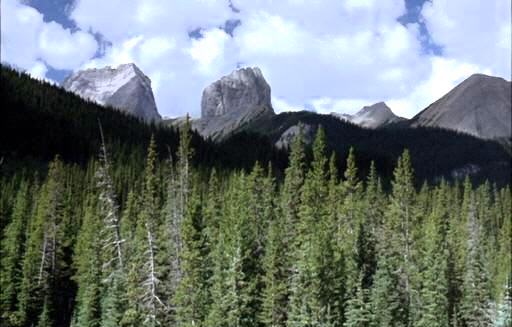
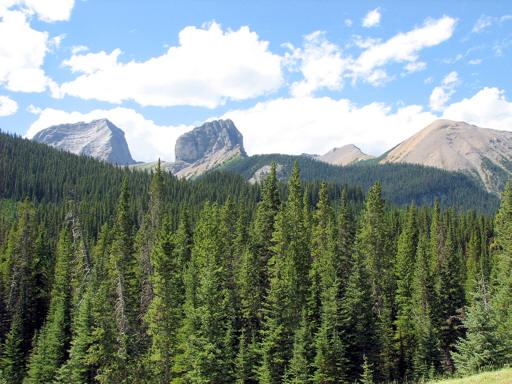
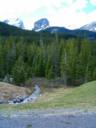
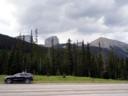
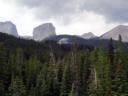
Three Mountains / The Fist is on Hwy 742, 39.5 km south
of the Three Sisters Drive intersection in Canmore, and
3.0 km north of “Gonna Snow” Lake. The
formations are to the right (west) behind the Smuts Creek
(Jump Creek) crossing.
To reach Hwy 742 (also known as Spray
Lakes Rd. / Smith-Dorrien Rd.): From Hwy 1 (Trans-Canada
Hwy), use Exit 91 “Hwy 1A - Canmore.” Follow
Bow Valley Trail 2.2 km, turn left (northwest) onto
Railway Ave. Proceed 0.5 km and turn left (west) at Main
St. (also known as 8th St.), go 0.6 km and turn left
(south) onto Bridge Rd. (also known as 8th Ave. / Rundle
Drive). At the “T” intersection, turn left
(south) on Three Sisters Drive, proceed 0.6 km and turn
right (west) at Spray Lakes Rd. (also known as Hwy 742).
(Or simply follow the helpful “Kananaskis
Country” signs throughout Canmore.) See map of Canmore.
Remarks:
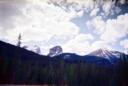
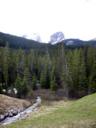
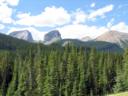
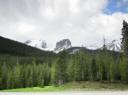
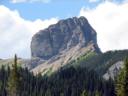
The Fist forms the centerpiece of this breathtaking
mountain group. Its neighbor to the left is Mount Smuts.
These are among the most familiar formations in the Spray
Range, which straddles the Alberta / British Columbia
border. Mount Smuts is among the region’s most
notoriously difficult climbs. Note the lovely creek
(Smuts Creek) that flows under Hwy 742. See:
http://www.peakfinder.com/peakfinder.ASP?PeakName=Mount+Smuts
http://www.albertaparks.ca/peter-lougheed.aspx
A much-celebrated statesman, lawyer,
soldier, politician, philosopher, and scientist, Jan
Smuts was a general in the Boer War, prime minister of
South Africa, founder of the League of Nations, author of
the Preamble of the United Nations charter, and president
of the British Association for the Advancement of
Science. The following is extracted from a speech Smuts
delivered on Table Mountain, Cape Town, South Africa, in
1923:
THE
SPIRIT OF THE MOUNTAIN
The Mountain is not merely
something externally sublime. It has a great
historical and spiritual meaning for us. It
stands for us as the ladder of life. Nay, more,
it is the great ladder of the soul, and in a
curious way the source of religion. From it came
the Law, from it came the Gospel in the Sermon on
the Mount. We may truly say that the highest
religion is the Religion of the Mountain.
What is that religion? When we
reach the mountain summits we leave behind us all
the things that weigh heavily down below on our
body and our spirit. We leave behind a feeling of
weakness and depression; we feel a new freedom, a
great exhilaration, an exaltation of the body no
less than of the spirit. We feel a great joy.
The Religion of the Mountain is
in reality the religion of joy, of the release of
the soul from the things that weigh it down and
fill it with a sense of weariness, sorrow and
defeat. The religion of joy realizes the freedom
of the soul, the soul’s kinship to the great
creative spirit, and its dominance over all the
things of sense. As the body has escaped from the
over-weight and depression of the sea, so the
soul must be released from all sense of
weariness, weakness and depression arising from
the fret, worry and friction of our daily lives.
We must feel that we are above it all, that the
soul is essentially free, and in freedom realizes
the joy of living.
We must fill our daily lives with
the spirit of joy and delight. We must carry this
spirit into our daily lives and tasks. We must
perform our work not grudgingly and as a burden
imposed upon, but in a spirit of cheerfulness,
goodwill and delight in it. Not only on the
mountain summits of life, not only on the heights
of success and achievement, but down in the deep
valleys of drudgery, of anxiety and defeat, we
must cultivate the great spirit of joyous freedom
and upliftment of the soul.
We must practice the Religion of
the Mountain down in the valleys also.
|
|